
ANDALUCIAPREMIUM
Request an offer
FertilizersSteelPrecious metalsTimberPetroleum products GuidesFAQHow we workAbout usContact Request an offer
ENESDE
  1. Home
  2. Guides
  3. Guide · Fertilizer types
Guide · Fertilizer types

Types of Fertilizer: Nutrient Content of Nitrogen, Phosphate, Potash and NPK Grades

Urea, ammonium nitrate, DAP, potash or NPK 15-15-15 – bulk mineral fertilizers differ mainly in which nutrients they supply and at what concentration. This guide sorts the main types, explains how grades are read and how fertilizer is made, and lists what bulk buyers check before they sign.

Last updated: October 20266 min readAndalucia Premium

In brief

Mineral fertilizers are grouped by their primary nutrients nitrogen (N), phosphate (P₂O₅) and potash (K₂O), often with sulphur and magnesium added.

Urea is the most concentrated solid nitrogen fertilizer at 46 % N, while potash and triple superphosphate contain no nitrogen at all.

The right product depends on soil, crop and local rules and should be determined through soil testing and agronomic advice.

What is a fertilizer made of?

A fertilizer is any material that supplies plants with nutrients. Mineral fertilizers consist of inorganic salts or compounds such as urea, ammonium nitrate, phosphates or potassium chloride.

Crops take most of their nutrients from the soil, and fertilizers top up what the soil cannot supply in sufficient quantity. Bulk mineral fertilizers are either manufactured industrially or mined, and each product carries a defined, declared nutrient content.

Besides the nutrient carrier itself, a product may contain additives such as anti-caking agents, coatings or inhibitors that slow down its conversion in the soil.
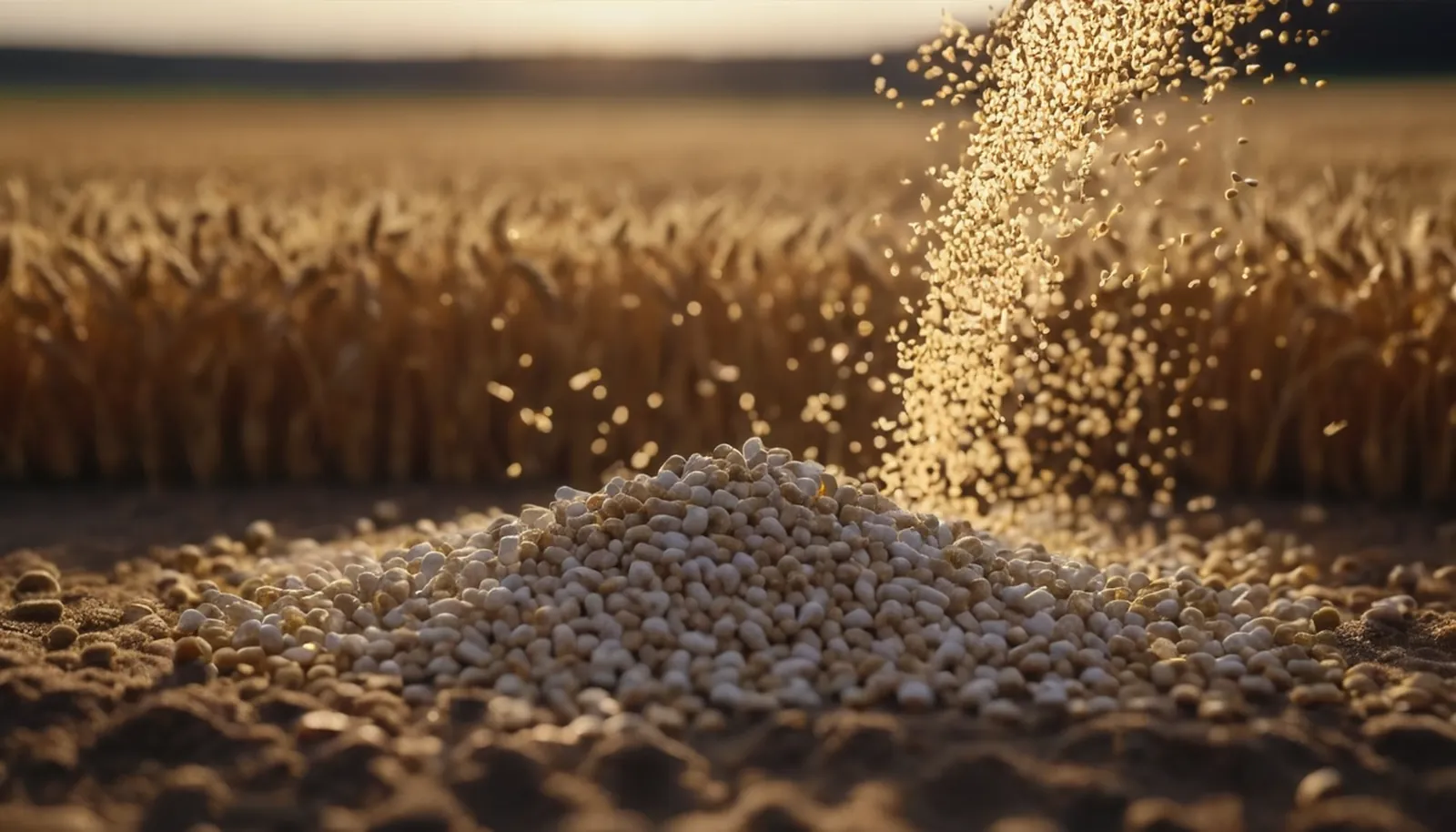
What are the main types of fertilizer?

Fertilizers are divided into straight products that supply one primary nutrient – nitrogen, phosphate or potash – and compound products such as NP, PK or NPK grades. They also come as mineral or organic, solid or liquid.

  • Nitrogen fertilizers: urea, ammonium nitrate, calcium ammonium nitrate (CAN), ammonium sulphate, urea ammonium nitrate solution (UAN)
  • Phosphate fertilizers: diammonium phosphate (DAP), monoammonium phosphate (MAP), triple superphosphate (TSP)
  • Potash fertilizers: muriate of potash (MOP), sulphate of potash (SOP)
  • Compound fertilizers: NPK, NP and PK grades in many formulations

Sulphur (S) and magnesium (Mg) are secondary nutrients and are supplied, for example, through ammonium sulphate or SOP.

Which nitrogen fertilizer has the highest N content?

Urea has the highest nitrogen content of all solid fertilizers at 46 % N. It is followed by ammonium nitrate at roughly 33.5–34.5 % N, liquid UAN at 28–32 % N, CAN at about 27 % N and ammonium sulphate at 21 % N.

Nitrogen fertilizerTypical N contentNote
Urea46 % Nsolid, granular or prilled
Ammonium nitrateapprox. 33.5–34.5 % Nstrict storage and transport safety rules
UAN solution28–32 % Nliquid
Calcium ammonium nitrate (CAN)approx. 27 % Nammonium nitrate blended with limestone or dolomite
Ammonium sulphate21 % Nplus approx. 24 % sulphur

For the most widely traded solid nitrogen fertilizer, see our urea 46 % guide.

Which fertilizers contain little or no nitrogen?

Potash fertilizers such as MOP and SOP, and triple superphosphate, contain no nitrogen. MAP and DAP carry some nitrogen but far more phosphate.

ProductNP₂O₅K₂O
Muriate of potash (MOP)0 %0 %approx. 60 %
Sulphate of potash (SOP)0 %0 %approx. 50 %
Triple superphosphate (TSP)0 %approx. 46 %0 %
MAP 11-52-011 %52 %0 %
DAP 18-46-018 %46 %0 %

Figures are typical commercial grades; the binding values are those in the contract specification.

What are phosphate and potash fertilizers such as DAP, MAP and MOP?

DAP (18-46-0) and MAP (11-52-0) are ammonium phosphates that deliver nitrogen and phosphate together, while TSP supplies about 46 % P₂O₅ without nitrogen. MOP (about 60 % K₂O) and SOP (about 50 % K₂O) are the main potash sources.

Ammonium phosphates are made from phosphoric acid and ammonia and rank among the most traded phosphate fertilizers worldwide; they are also a common base for blends. SOP is low in chloride and also supplies sulphur, which is why it is used for chloride-sensitive crops, whereas MOP is the standard potash source.

NPK fertilizer meaning: how do you read 15-15-15?

The three numbers state the content of nitrogen (N), phosphate (P₂O₅) and potash (K₂O) as a percentage by weight. NPK 15-15-15 therefore contains 15 % of each.

Phosphorus and potassium are expressed as oxides by convention, not as the pure element. Additions such as “+ 2 MgO + 6 S” declare secondary nutrients. The numbers stay well below 100 % because the rest of the weight is made up of bound elements such as oxygen, hydrogen or chloride and of other constituents.

NPK products are sold either as complex (compound) fertilizers, where every granule contains all nutrients, or as bulk blends mixed from straight components.

How is fertilizer made?

Nitrogen fertilizers start from ammonia produced by the Haber-Bosch process, phosphate fertilizers from phosphate rock treated with acid, and potash fertilizers from mined potash salts.

  • Ammonia: nitrogen from the air reacts with hydrogen, usually obtained from natural gas.
  • Urea: synthesised from ammonia and carbon dioxide.
  • Ammonium nitrate: made from ammonia and nitric acid, which itself is produced from ammonia.
  • Phosphates: phosphate rock is digested with sulphuric acid to make phosphoric acid, which reacts with ammonia to form DAP and MAP.
  • Potash: potash ore is mined or extracted from brines and refined into potassium chloride.

Because natural gas is both feedstock and energy source for nitrogen products, gas prices weigh heavily on production costs.

Mineral or organic: which fertilizer is best?

There is no single best fertilizer. Mineral fertilizers deliver nutrients in a defined, readily available form, while organic materials such as manure or compost act more slowly and also build soil organic matter.

Which product, and how much of it, makes sense depends on soil type, nutrient status, crop, climate and local regulation – and is worked out through soil analysis and agronomic advice. This guide does not give application rates.

Overuse matters too: surplus nitrogen can leach into groundwater as nitrate, which is why the EU Nitrates Directive restricts nitrogen inputs.

We only broker bulk mineral fertilizers, not organic products.

Bulk fertilizer suppliers: what should buyers check?

Buyers check the specification, the certificate of analysis, origin, packaging and compliance with the rules of the destination market. For CE-marked products in the EU, the Fertilising Products Regulation (EU) 2019/1009 applies.

  • Specification: nutrient content, moisture, granule size, physical form, impurities
  • Certificate of analysis (CoA) and certificate of origin, ideally confirmed by independent inspection at loading
  • Packaging: 50 kg bags, big bags or loose in bulk
  • Compliance: labelling, registration and safety rules, for example for ammonium nitrate

Our guide to inspection and CoA/CoO certificates explains the documents in detail. See the fertilizers section for the products we broker, or send your specification and volume via contact.

Last updated: October 2026This page provides general information about trade practice. It is not legal, tax or investment advice.

FAQ

Frequently asked questions

Commodity trading questions, answered

What are the most common types of fertilizer?

The most widely traded mineral fertilizers are urea, ammonium nitrate and CAN for nitrogen, DAP and MAP for phosphate, muriate of potash for potassium, and NPK compounds.

What does NPK mean on a fertilizer bag?

NPK stands for nitrogen, phosphorus and potassium. The three numbers give the content of N, P₂O₅ and K₂O as a percentage by weight, in that order.

What is the strongest nitrogen fertilizer?

Among solid fertilizers, urea has the highest nitrogen content at 46 % N. Anhydrous ammonia is even more concentrated but is a pressurised gas that needs special equipment.

What is bulk fertilizer?

Bulk fertilizer is product shipped loose rather than packed, typically in the holds of bulk carriers, and discharged into warehouses or trucks at the port of destination.

How is fertilizer packed for international trade?

Common formats are 50 kg bags, big bags of usually around one tonne and loose bulk cargo. Liquid fertilizers such as UAN travel in tank trucks or tankers.

Why is excessive fertilizer use a problem?

Nutrients that crops do not take up can leach into water as nitrate or escape as ammonia and nitrous oxide. Rules such as the EU Nitrates Directive limit nitrogen inputs for this reason.

Do you sell fertilizer in small quantities?

No. We broker mineral fertilizers in container and bulk volumes between verified companies and do not trade on our own account. Small garden quantities are available from retailers.

Sectors

What we broker

Contact

Do you have a requirement or an offer?

Tell us the product, specification, quantity, delivery window and destination port. We will reply personally with the next steps.

Request an offer
Request an offer